P8X — a hand-built 8-bit TTL CPU
P8X is an 8-bit computer designed from scratch in 74HCT logic — about 130 chips on six cards plugged into a passive backplane, with no microprocessor. Every instruction is microcoded: four EPROMs hold a control word for each step of each instruction, and the same microcode images the EPROMs are burned from are what the emulator runs. P8X also exists a second time, as an FPGA build of the same microarchitecture that boots the same, unmodified software, and that build carries a graphics engine with hardware 3D. Around both sits a complete software stack: a ROM monitor, a disk operating system with dozens of commands, BASIC, an assembler and C compilers.
I'm Ken Rother. I designed P8X, and it runs on an FPGA. Claude, Anthropic's AI, has been directly involved in its design, coding and documentation.
Source on GitHub My other projects
At a glance
| Data path | 8-bit data bus, 16-bit address bus; an ALU of two 74181s and a 74182 carry-lookahead, with a shifter |
| Registers | A and B; four 16-bit pointer registers, P0–P3 (P0 is the program counter, P3 the stack pointer), one of which always drives the address bus; flags C, Z, N, V |
| Address space | 64K: 6 KB of ROM at $0000, RAM from $1800 to $FEFF, and an I/O page at $FF00 |
| Instructions | 143 opcodes, all microcoded; the microcode address is the opcode, the step and the condition |
| Construction | about 130 74HCT chips on six cards, in a passive 8-slot backplane with a 96-pin DIN 41612 bus |
| Clock | a 4 MHz oscillator, divided by 1, 2, 4 or 8 (a jumper) |
| Console | RS-232 serial through a 6850 ACIA |
| Disk | CompactFlash in 8-bit True IDE mode, two drives |
| FPGA build | a Sipeed Tang Nano 20K: 9 MHz, a microSD card as the disk, a 4.3" 480×272 colour panel |
What it runs
- The monitor ROM — examine and change memory, dump it, initialise, format and boot the disk, run programs; and a
BIOS jump table at
$0100that programs call. (ROM monitor) - P8X/OS — a disk operating system loaded from CompactFlash, with a hierarchical filesystem, a shell with
redirection, pipes, command history and Tab completion,
make, and a second card mounted at/d1. The commands have manual pages, on the disk and here. (P8X/OS) - BASIC — an interpreter written in P8X assembler, with statements for the graphics display. (BASIC programmer's guide)
- A toolchain on the machine itself — a line editor and
vi, an assembler whose output is byte-identical to the host assembler's, and C compilers: one written in assembler, and one written in C that compiles its own source on P8X and reproduces itself byte for byte. (On-target tools) - Tools on the Mac — the C cross-compiler that builds every
/bincommand, the assembler, and a cycle-accurate emulator that runs the microcode images rather than a model of the instructions. (C compiler, assembler, emulator)
The cards
-
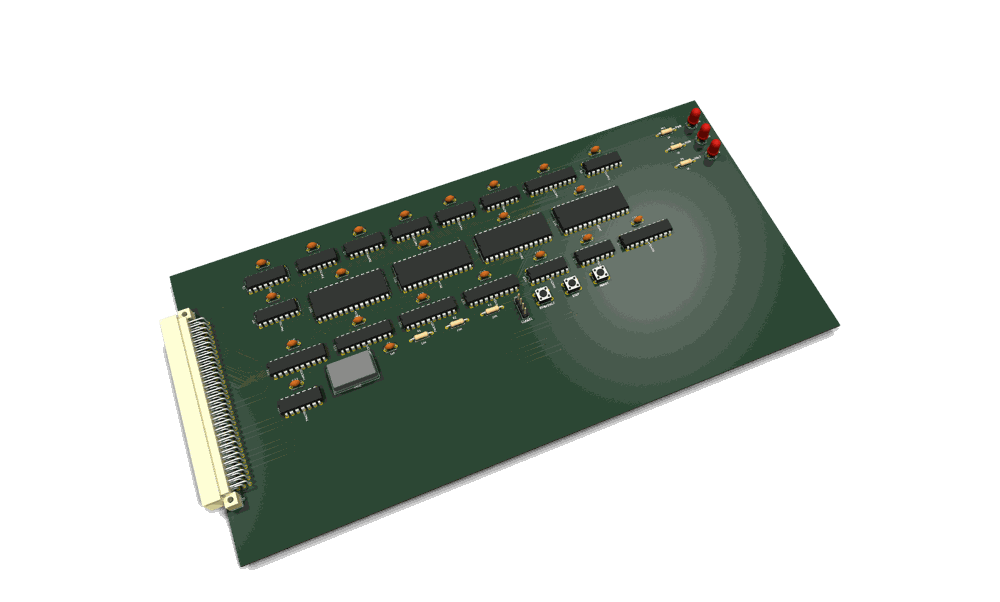
Control / microcode — the clock, reset and front-panel run controls, the instruction register, and the microcode engine that drives every other card over the backplane.
-
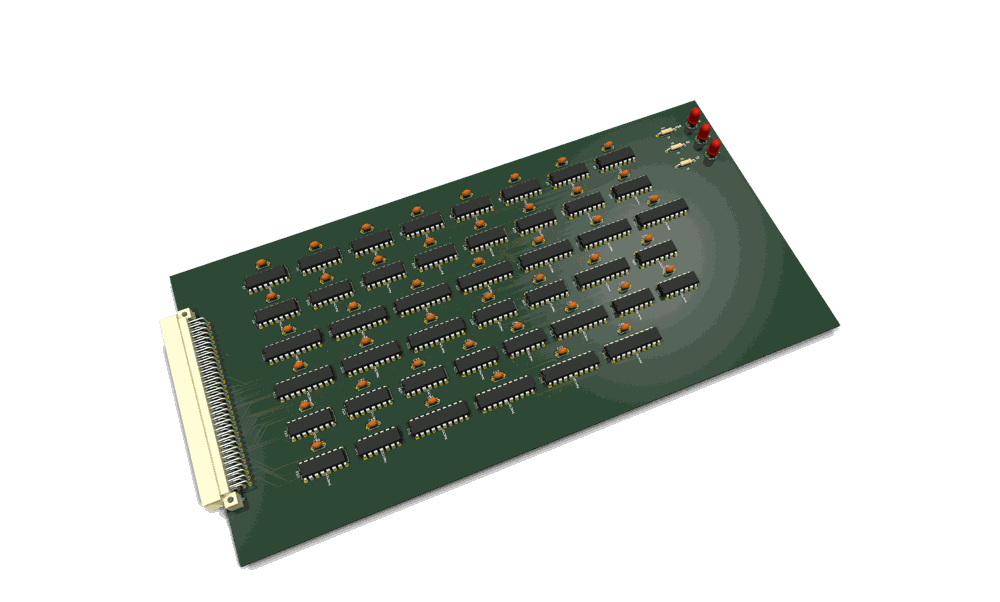
Register bank — the four 16-bit pointer registers, built from 74169 up/down counters; there is no separate memory address register.
-
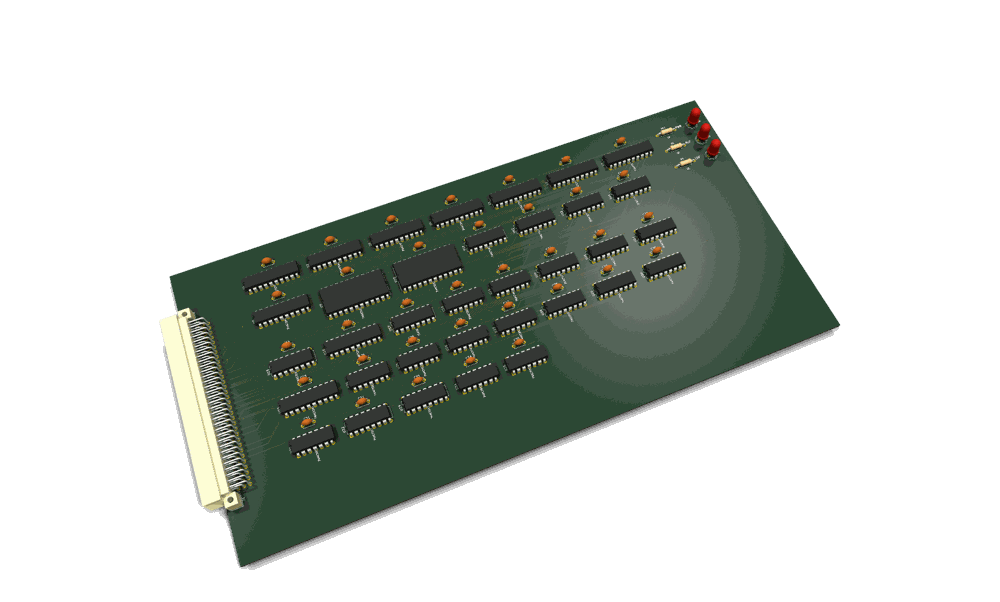
ALU — the A and B registers, two hidden temporaries for the microcode, the 74181 ALU, the shifter and the flags.
-
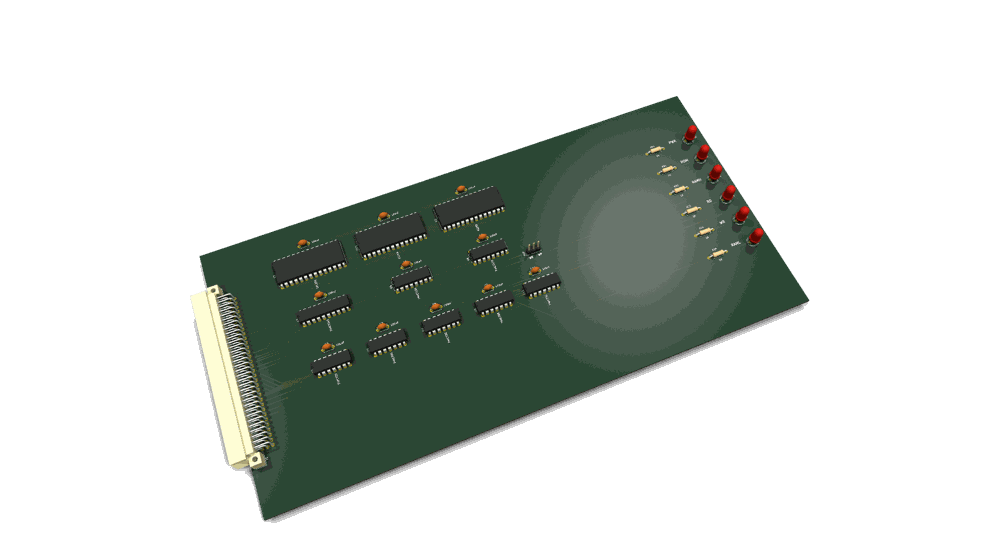
Memory — the ROM and RAM and their address decode.
-
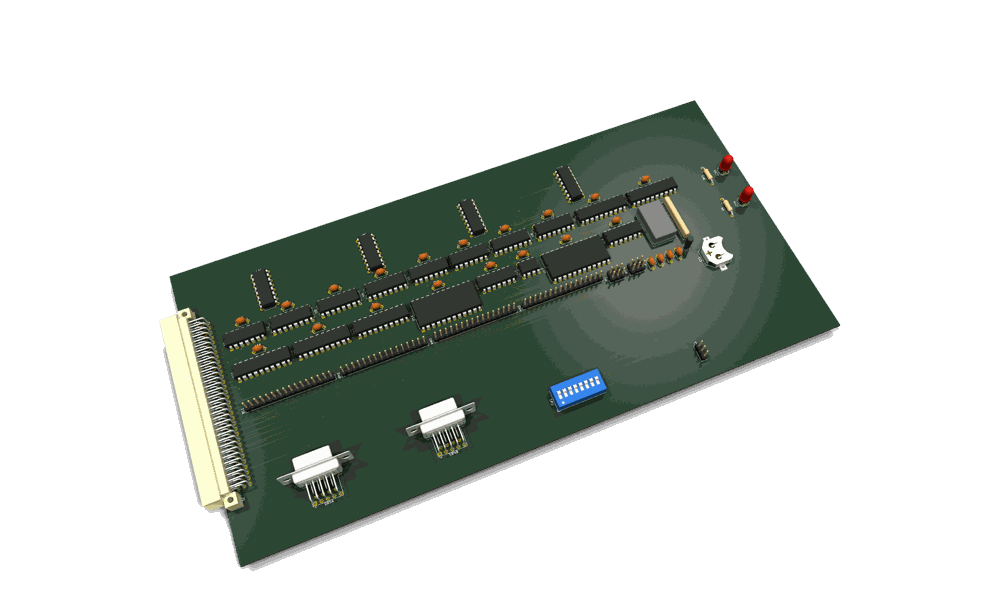
I/O — switches, LEDs, the serial ports, and a bus monitor of LEDs that shows the machine at work.
-
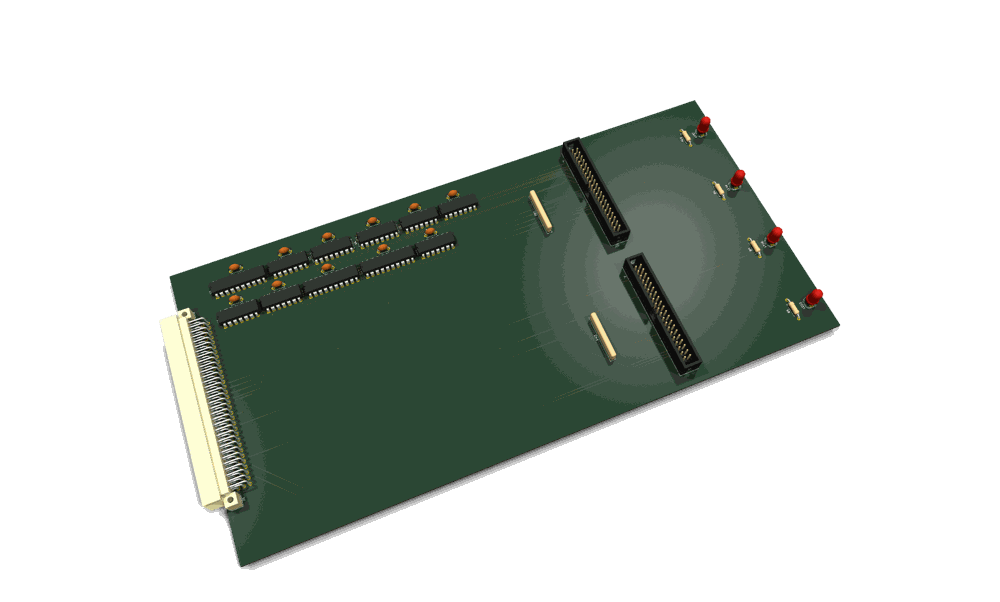
CF-IDE — two CompactFlash drives in 8-bit True IDE mode, in the I/O page.
-
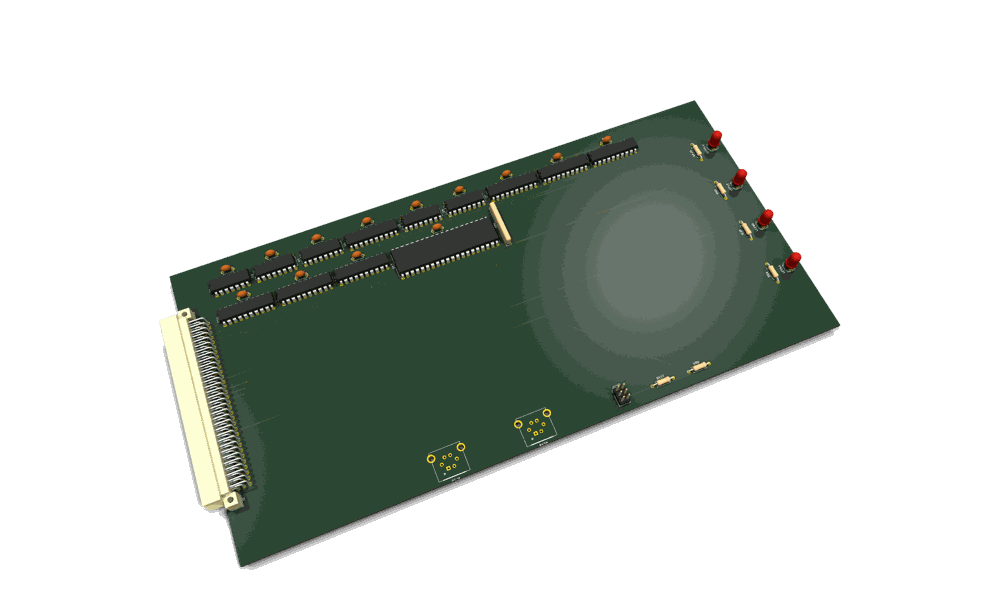
PS/2 — a keyboard port and a mouse port at
$FF58–$FF5F. -
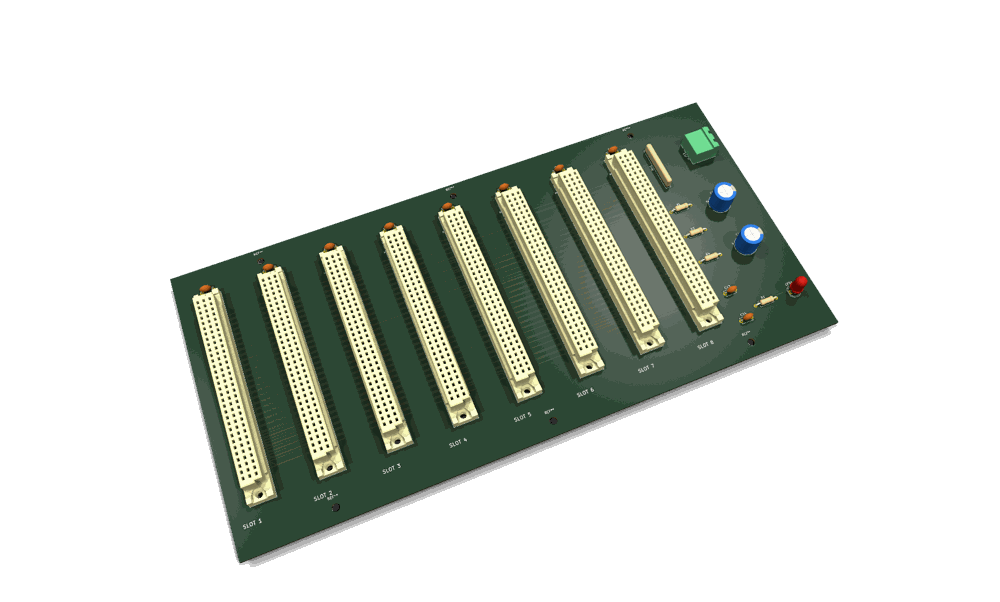
Backplane — eight slots on a passive 96-pin bus that carries the microcode control word itself (bus definition).
-
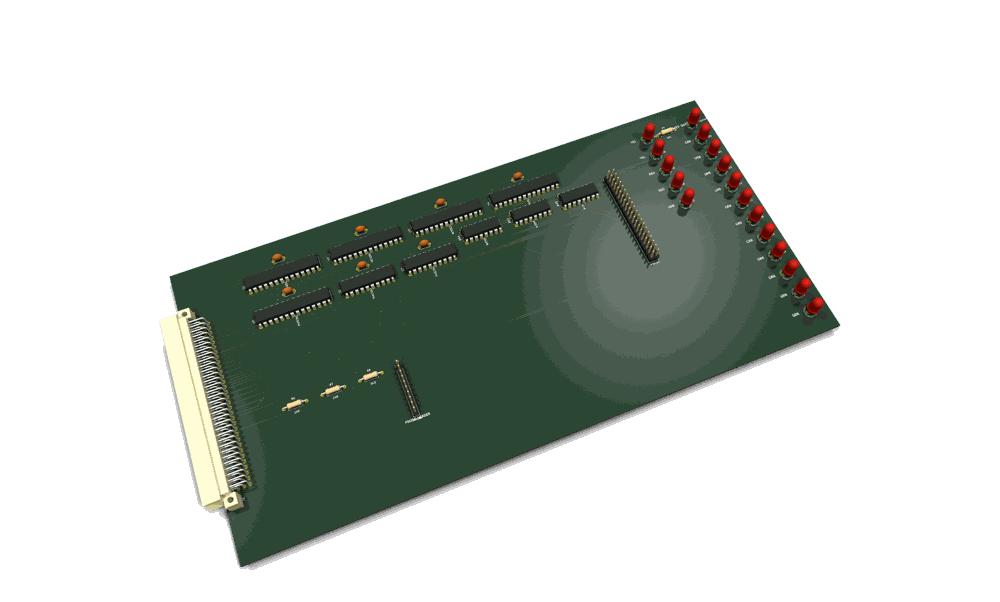
Bus test card — a USB-attached card that sits where the control card would and drives the bus one microcycle at a time, to bring up each card on its own.
These are renders of the KiCad boards. All of them are routed; the plug-in cards are all 280 × 140 mm with four layers. See KiCad boards and build readiness.
The FPGA build and the graphics engine
The FPGA build puts the whole machine — CPU, memory, serial console, disk and display — into one Gowin chip on a Tang Nano 20K; one USB cable programs it and carries the serial console. It is a parallel track to the TTL cards, not a replacement: the same microcode, sequencer and pointer registers, so the monitor, OS, BASIC, assembler and C compiler run on it unmodified. It is checked by running the same program on the Verilog and on the emulator and comparing their state cycle by cycle (co-simulation).
It also carries a graphics engine for a 480×272 panel in 16-bit colour: a graphics language modelled on the Matrox PG-640A, with hardware 3D transforms, clipping and command lists, a multiply-divide unit and a geometry engine. Programs draw through it from the shell, BASIC, C or assembler, and the emulator models the same device so the two can be compared frame by frame. When a display is present, the same OS shows its console on the screen and offers a desktop with a Finder and full-screen applications; without one, it runs over the serial console. (Graphics theory of operation, graphics programmer's guide, two-mode operation)
Where to start
| If you want to... | Read |
|---|---|
| understand how it works | System design, then the bus definition |
| look up an instruction | the instruction set quick reference or the programmer's guide |
| program it | the memory map, the ROM monitor and the BASIC guide |
| use the OS | P8X/OS and the commands |
| look at the hardware | the hardware overview and each card's theory of operation |
| draw on the screen | the graphics programmer's guide |
| decode an abbreviation | the glossary |
| see what is being worked on | Where P8X stands, then the backlog |
| build it from source | Working on the code |
Status (October 2026)
- Running on the FPGA build: the monitor, P8X/OS booting from a microSD card, the whole
/bintoolchain, and the graphics engine. Next there: the RTL follows the 6 KB ROM map ($1800–$1FFFis RAM), then a faster clock than today's 9 MHz, and interrupts. - TTL cards: all boards are designed and routed in KiCad; none is fabricated yet. The memory card (rev F) already decodes the 6 KB ROM. Before ordering, the register bank gains a counting scratch pointer and a second one for the 16-bit instructions (rev D), and the second CF drive's port gets its software; the backplane is ordered first. An interrupt controller card is still to be designed.
- Software: the C compiler compiles itself on P8X. Next on the list: pipes of more than two stages
(
a | b | c), and opening a file by name as a single system call.
More in Where P8X stands.